29 January 2026
Next step to make Brunswick boom gate free
We’re removing 8 more level crossings on the Upfield Line from Albion Street, Brunswick, to Park Street, Parkville by building a 2.1km rail bridge over the roads.
This transformative project will improve public and active transport, unlock new open space and enable future enhancements to the Upfield Line.
We’ll build new accessible stations in Brunswick’s north and south connecting passengers with the places they live, study, work and enjoy – including RMIT University, community and educational facilities and vibrant retail and dining precincts.
Removing the level crossings and building 2 new stations in new locations is critical to enabling for future upgrades of the Upfield Line. Getting rid of these crossings will improve traffic flow, eliminating half an hour of boom gate down time in the morning peak alone, saving travel time for 71,000 drivers each weekday.
As part of the project, we'll create 2 MCGs worth of new community open space and transform the Upfield Bike Path by delivering separated walking and cycling paths. The new paths will create safer journeys for the 2500 bike riders and pedestrians who already use the path daily. Thanks to everyone who shared feedback in our first phase of community consultation. We're continuing early design work with concept designs being released in 2027, followed by further phases of consultation.
As we progress design and planning, we've referred the project to the Minister for Planning to review and decide if further assessments are required under the Victorian Environment Effects Act 1978.
Why these level crossings need to go
- 71,000 vehicles travel through these crossings each weekday
- Boom gates are down for up to 30 minutes of the morning peak (7am to 9am)
- Up to 16 trains pass through these crossings during the morning peak (7am to 9am)
- 36 near misses since 2016
All 8 level crossings will be gone and the new stations will open in 2030.
Thanks for having your say
In 2024, we asked the local community to share how they move around the area and what they love about Brunswick and Parkville. Your feedback, along with technical and engineering requirements, is helping shape the project's concept designs, which will be released from 2027.
We received more than 1600 valuable pieces of feedback via our Engage Victoria vision and values and map surveys, station pop-ups, information sessions and our Big Build contact centre.
We look forward to sharing these concept designs and hearing your feedback during future phases of community consultation.
With more than 54 new or upgraded stations opened and 88 level crossings removed so far, our engineers and designers have vast experience in creating liveable new spaces. We don’t only remove level crossings – we deliver new community facilities and open spaces for generations to come.
Vision and values insights
- Walking, cycling and using the tram are the most common ways locals get around Brunswick and Parkville.
- People are most interested in the new separated walking and cycling paths (68%), new stations (65%) and urban design (56%).
- Locals’ top priorities for the new stations: improved connections between the station and surrounding destinations, good bike connections and pedestrian paths in and around the precinct.
- 83% of people walk to and from the train station.
What is important to you
- Connectivity – Locals love the area's connectivity, with easy access to different public and active transport options. We heard how walkable and bike friendly Brunswick and Parkville are. Many shared the project is an opportunity to improve paths and connections.
- Inclusive community spaces – Locals highly value Brunswick and Parkville’s sense of community, diversity and character. We heard the community want active recreation areas, with a variety of features that will be accessible and cater for all ages along with open space with natural light, seating and shaded areas. We’ll invite community input on open spaces in the coming years.
- Landscaping and new open space – The community want the project to include more greenery, including native and indigenous plantings, to enhance biodiversity. We’ll invite community feedback on landscaping in the coming years. Locals value the unique community spaces in the area and want more places to come together and connect, plus extra green areas once the rail line is elevated.
- Heritage – Many locals highlighted the area celebrates and recognises First Nations history and industrial heritage. Locals want the project design to reflect rail and industrial heritage, along with First Nations culture.
Find out more in the community consultation report.
Progressing planning approvals
Planning approvals are an integral part of every level crossing removal project.
We work with the Department of Transport and Planning, Heritage Victoria, Environmental Protection Authority Victoria, the Department of Energy, Environment and Climate Action and Registered Aboriginal Parties to ensure we meet all regulatory standards and requirements.
Under the Victorian Environment Effects Act 1978 (EE Act), we assess potential impacts of the project and consider a range of environmental, heritage, social and economic matters.
As this project has the potential to meet 2 of the EE Act combined criteria - visual amenity and heritage - it has been referred to the Minister for Planning to determine whether an Environment Effects Statement (EES) is required.
An EES may not be required if existing legislation, approval processes and procedures are considered sufficient to manage the potential environmental effects.
The Brunswick and Parkville level crossing removal project is a significant opportunity to invest in the local area and make the community an even better place to live, work and play.
These processes are an important step in shaping great communities, while minimising local impacts.
Frequently Asked Questions
What is an EES referral?
An Environment Effects Statement (EES) referral is a submission to the Minister for Planning who will determine whether an EES is required. There are individual criteria and combined criteria to determine whether a project requires a referral.
Learn more on the Department of Transport and Planning website.
Why was the project referred?
The Brunswick and Parkville level crossing removal project has the potential to meet the combined referral criteria, as it has 2 types of potential effects on the environment - potential impacts to heritage places and visual amenity.
What is in the EES referral?
The referral covers a wide range of topics, including:
- an overview of the project and approach to urban design
- the project area, including areas that may be used for construction or to store materials
- how we plan to manage and mitigate any potential for environmental effects
- a description of existing environmental conditions
- assessments of construction and project effects on ecology, heritage, planning, noise and vibration and traffic.
Where can I read the EES referral?
All EES referrals are available on the Department of Transport and Planning website.
What is the next step in the referral process?
The Minister for Planning will review the referral and decide if the project requires further assessment under the EE Act or if existing legislation and approval processes are sufficient to manage the potential environmental effects of the project.
The Minister’s decision will be available at Department of Transport and Planning website.
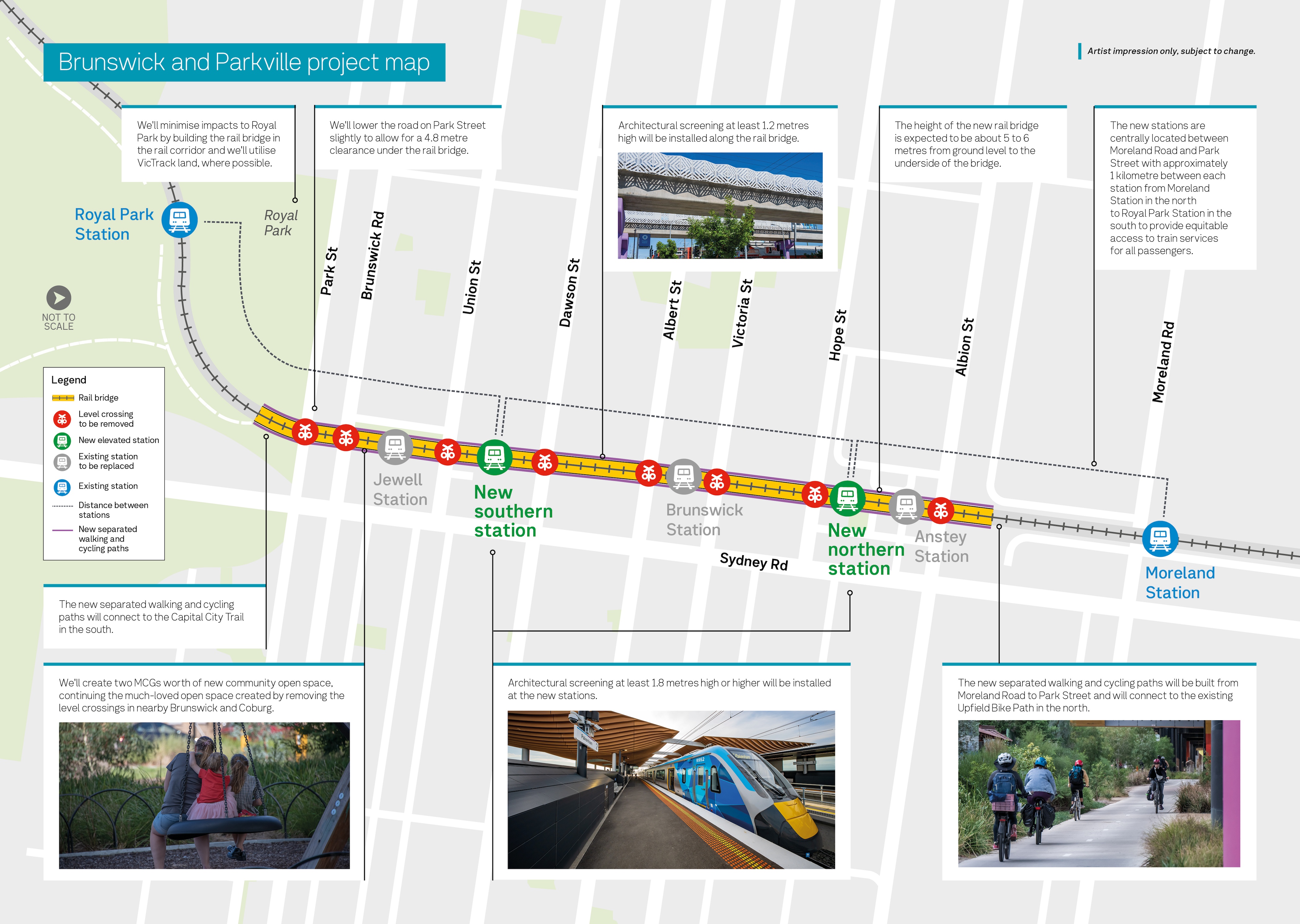
Please click the image to zoom in.
Advantages of the rail bridge over the roads in Brunswick and Parkville
Locals don't have to look far to see the benefits of a rail bridge over the road. This project follows the level crossing removals at Bell, Munro and Reynard streets and Moreland Road, new stations at Coburg and Moreland and 2 MCGs worth of new open space including half basketball courts, table tennis tables, skate and parkour areas, playgrounds, exercise equipment and a dog park.
- 2 MCGs worth of new community open space
- new separated walking and cycling paths
- improves safety for locals and all road users
- connects the community by elevating the rail line
- more trees and landscaping in the new open space
- new east-west connections
- more reliable travel times with no boom gate delays
- paves the way for more trains on the Upfield Line in the future
- minimises disruption during construction and compulsory property acquisition compared to other design solutions.
Brunswick's 2 new stations
We’ll build new accessible stations in Brunswick’s north and south connecting passengers with the places they live, study, work and enjoy – including RMIT University, community and educational facilities and vibrant retail and dining precincts.
The new northern station will:
- be centrally located between West Street and Hope Street
- provide access to West Street and Orient Grove via a northern entrance and to Hope Street via a southern entrance
- connect passengers to Sydney Road via Florence Street and Hope Street.
The new southern station will:
- be centrally located between Dawson Street and Union Street
- provide access to Dawson Street via a northern entrance and to Railway Place and Union Street via a southern entrance
- connect passengers to RMIT University, Brunswick Secondary College, Brunswick Baths, Sydney Road, Brunswick Library, Brunswick Town Hall and Balam Balam Place.
Extensive technical and engineering assessments determined the locations for the new elevated stations.
To provide equitable access to train services for all passengers, including residents and people travelling to Brunswick for work, study or play, there will be approximately 1km between each station, from Moreland Station in the north to Royal Park Station in the south.
This spacing also avoids creating future rail bottlenecks - ensuring more services can be added to the Upfield Line with consistent train speeds and stopping distances along the corridor.
To ensure Brunswick's new stations meet accessibility standards, the new locations allow for the platforms to be built on a straight section of track.
The new stations will be fully accessible for passengers of all abilities, with capacity to serve the community for the years ahead.
We've heard the community want station designs that fit in the local area and are sustainable. We’re working with designers experienced in designing rail bridges, elevated stations and rail infrastructure in complex environments such as the narrow rail corridor to minimise impacts of the new stations, where possible.
We're working with the Department of Transport and Planning to ensure new stations, active transport connections and new open space are considered by Brunswick and Coburg Activity Centres program. To learn more visit Engage Victoria.
We’ve prioritised using existing available land in the rail corridor to minimise compulsory property acquisition.
The northern station is constrained by the Victorian heritage-registered and state-significant site, the Former Brunswick Gas & Coke Retort House on Hope Street and the station location minimises impact to this site.
More trains, more often for the Upfield Line
The Metro Tunnel is now open, with the Sunbury, Cranbourne and Pakenham Lines taken out of the existing City Loop - freeing up space across the network for more services to be added for generations to come. Later this year, wait times on the Upfield Line will be slashed by up to half, with more trains, more often on evenings and weekends.
Improving accessibility and active transport
Each station will offer convenient access with 2 entrances, one at each end of the 160m platforms. The stations will be built to accessibility standards, with lifts, tactiles and hearing loops. Straight platforms are also critical to meeting accessibility and rail safety standards.
We’ll also improve station access for all as we're transforming the Upfield Bike Path, delivering new separated walking and cycling paths from Moreland Road to Park Street.
The walking and cycling paths will run through the station precincts and will offer a safer, easier and more direct route to the stations.
These new paths will meet modern standards and will be accessible for everyone, providing more space for people using mobility aids, prams and riding bikes and scooters.
This means safe and accessible active transport options for all to key destinations, including retail and dining precincts and education facilities as Brunswick and Parkville continue to grow.
Building a rail bridge over the roads, will also remove the barrier of the rail line, creating a more connected and accessible community.
Creating new open space
The new stations will be located within 2 MCGs worth of new community open space under and on either side of the elevated rail line.
The new open space will be developed with input from the community and opportunities may include gardens with trees and landscaping, dog parks, gathering places with tables and seating, recreation areas with BBQs, sport facilities for basketball, netball and soccer, an amphitheatre, exercise equipment and playgrounds.
New trains for the Upfield Line
The Upfield Line will welcome brand-new X'Trapolis 2.0 trains over coming years, transforming the passenger experience as longer-serving trains are gradually retired.
Each train can carry more than 1200 passengers, almost 10% more than the Comeng type trains they will replace.
The trains will improve accessibility with more spaces for wheelchair users, bicycle and pram storage, semi-automatic boarding ramps, hearing loops, real-time passenger information displays, and open access between carriages.
These trains are made in Victoria, for Victorians and are being tested on the network, before starting passenger services.
Find out more in our information booklet.
Join us to learn more
You're invited to come to one of our information sessions, where you can learn about the project and ask the project team questions.
See us in person
Venue: T.O.M.S Place, 1 Tripovich Street, Brunswick
- Session 1: Tuesday 24 February, 5.30pm to 8.30pm
- Session 2: Thursday 26 February, 5.30pm to 8.30pm
Online via Zoom
- Session 1: Monday 16 February, 6.00pm to 7.00pm
- Session 2: Thursday 19 February, 12.30pm to 1.30pm
- Session 3: Monday 23 February, 12.30pm to 1.30pm
Bookings required. Register and ask questions at Engage Victoria.